
Stepping Out of the Web 2.0 Shadow: Deconstructing the Core of GEO in the Generative AI Era - From Pre-trained Foundations to RAG Retrieval
Recently, an article titled "Is Traditional Chinese Marginalized by AI? The Best Strategy for Taiwanese Brands to Navigate AI Search GEO" by Sega Cheng sparked lively discussions in the marketing and PR circles. The piece astutely observes that "Earned Media is the common upstream source for AI citations," a point that highly aligns with the PR industry's long-standing emphasis on the value of objective endorsement.
However, when examining the underlying architecture of Large Language Models (LLMs), the article restricts GEO (Generative Engine Optimization) to a "Traditional Chinese data vacuum" and attempts to rank a "static priority list of platforms" for brands. This approach essentially forces the Web 2.0 SEO traffic logic into the Web 3.0 AI semantic world.
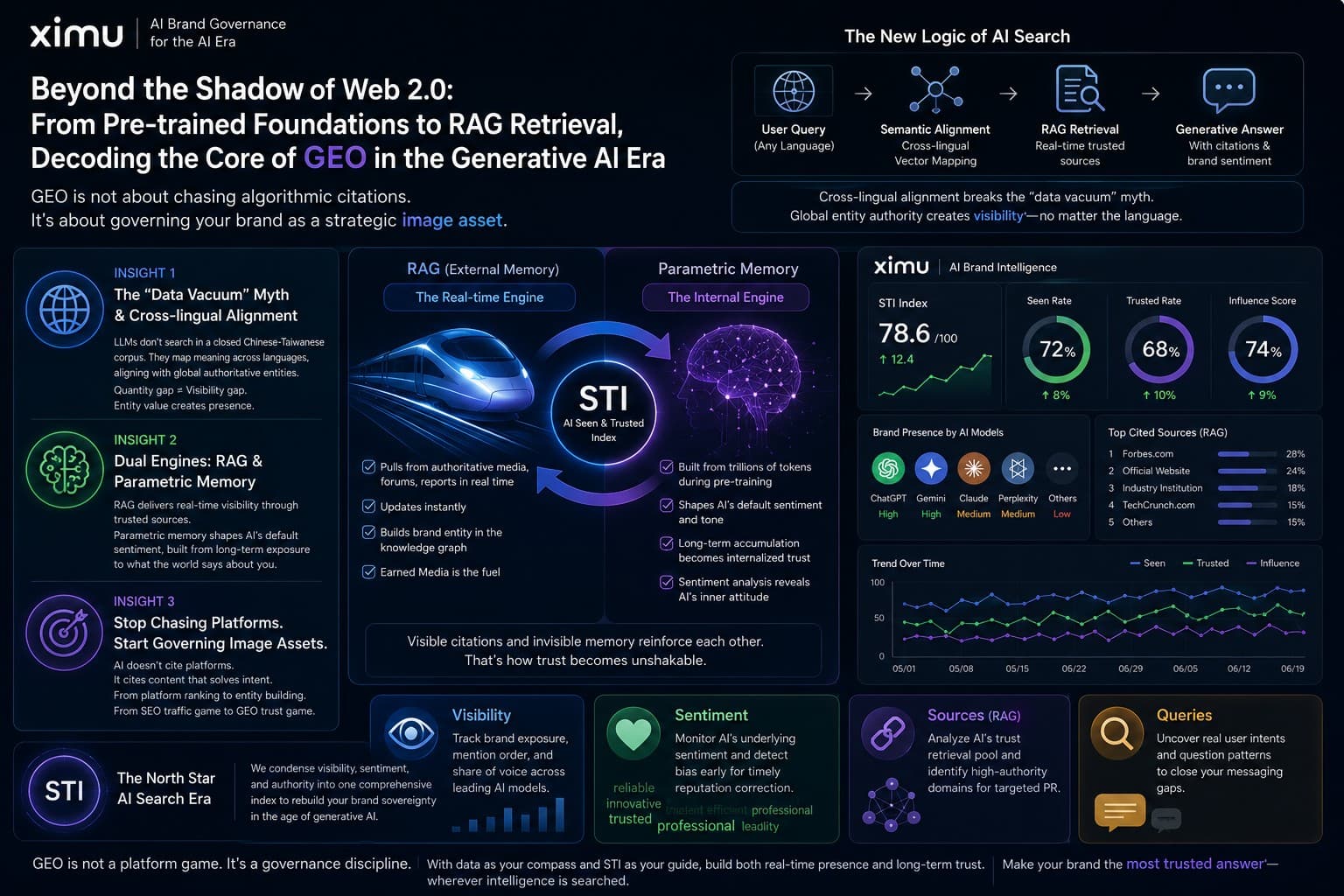
As the creator of the ximu platform, we believe that true GEO is not a speculative game of "calculating which URL the algorithm cited today." Rather, it is an in-depth practice of Image Asset Governance. Starting from the underlying operational logic of AI, we aim to deconstruct the technical blind spots and propose a more holistic strategic mindset.
Blind Spot 1: The False Premise of a "Traditional Chinese Data Vacuum" and Cross-lingual Semantic Alignment
The original article argues that Taiwanese brands face a data vacuum because of a lack of open citation research in Traditional Chinese and its weak global presence. This deduction underestimates the most fundamental technical advantage of modern LLMs: Cross-lingual Semantic Alignment.
The Underlying Technical Logic
When a user enters a query in Traditional Chinese, the AI search engine does not simply match keywords within an isolated "Traditional Chinese domain database." Instead, the AI converts the prompt into high-dimensional Vector Embeddings, crossing language boundaries in the Latent Space to semantically align with the world's most authoritative knowledge entities.
Our Perspective
A "volume vacuum" in Traditional Chinese does not equate to a "visibility vacuum" for a brand. If a Taiwanese brand has accumulated sufficient entity authority in global technical literature, international PR coverage, or open-source communities, AI retains the ability to cross language barriers, retrieve these global assets, and translate them into precise Traditional Chinese recommendations during the generation phase.
Strategic Insight
Brands shouldn't be anxious about "spamming posts on local Taiwanese platforms." Instead, they should focus on whether the brand possesses an irreplaceable "entity value" within the cross-lingual global knowledge graph.
Blind Spot 2: The Dual-Track Symbiosis of RAG and Parametric Memory
The Indispensable Real-time Citations and Emotional Base
The original article spent significant time discussing the "citation rates" of various platforms but overlooked that an AI search engine's response is woven from two distinct forces: Retrieval-Augmented Generation (RAG) and Parametric Memory. In discussing GEO, exaggerating parametric memory for the sake of a "unique insight," or looking solely at RAG URL citations, misses the forest for the trees.
RAG (External Memory) is the "Real-Time Engine" for Building Brand Entities
In the process of shaping a brand's global entity, the first and fastest-acting mechanism is inevitably the RAG citations generated through authoritative media and forums. Expecting AI to spit out accurate evaluations of your brand based purely on its parametric memory without web browsing is an incredibly high hurdle—unless you are a global tech giant. Therefore, actively securing high-authority Earned Media to capture real-time RAG retrieval is a brand's first line of defense.
Parametric Memory (Endogenous Skeleton) Determines AI's "Default Sentiment" Toward You
Parametric memory is the endogenous common sense formed after the model ingests trillions of tokens during its pre-training phase. It is crucial to understand this: AI's parametric memory is essentially built by continuously absorbing the long-term linguistic evaluations of your brand from authoritative media and user forums (e.g., G2, Reddit, PTT, Dcard).
If a brand abandons governance simply because its "direct citation rate is zero" on certain platforms, it is effectively giving up the long-term data that feeds the AI's parametric memory. In ximu's Sentiment analysis dimension, we track not only real-time RAG URLs but also quantify the AI's internal attitude toward the brand, using a "Sentiment Word Cloud" to reconstruct the emotional base the model has accumulated in its parametric memory.
Strategic Insight
RAG brings real-time visibility, and the long-term accumulation of RAG eventually internalizes into AI's parametric sentiment. Visible citations and invisible memory are complementary dual engines.
Blind Spot 3: Chasing Drifting Platforms vs. Practicing "Image Asset Governance"
The original article attempts to compile a "platform priority master list" for brands, yet it admits that "algorithms drift significantly within weeks." This perfectly exposes how "platform-oriented" GEO operations are destined to become a futile rat race.
The Conflict of Core Methodologies
| Era | Core Logic |
|---|---|
| Web 2.0 SEO | Securing positions on platforms to distribute traffic |
| Generative AI GEO | Managing content entities to earn AI's trust |
AI cites specific platforms because the content on that page resolves the user's high-level intent, not because the platform itself is granted special privileges.
ximu's Image Asset Governance and Practice
We advocate elevating PR and content to the level of "Asset Governance." This receives scientific guidance through ximu's Sources function: We do not blindly trust generic market platform rankings. Instead, we filter out specific domains in an industry that have a "highly cited rate but zero mentions of the client's brand." These domains are the established trust anchors for AI in that specific field. Brands should execute Targeted PR against these specific nodes rather than generically managing social media platforms.
Conclusion: Reshaping Brand Sovereignty in the AI Search Era with the STI Composite Metric
The emergence of Generative AI Search (GEO) marks the end of the "keyword stuffing" and "Click-Through Rate (CTR)" era. We can no longer simplify AI into an "advanced version of Google that spits out links."
To provide brands with a truly guiding North Star metric, ximu condenses surface-level exposure, deep-level sentiment, and authority into the STI (Seen & Trusted Index). Under ximu's methodology, GEO must be dynamically reviewed across four key dimensions:
- Visibility — Tracking a brand's Reach and Priority across mainstream models like ChatGPT, Gemini, and Claude to ensure the brand doesn't become invisible in AI channels.
- Sentiment — Monitoring the friendliness of AI's underlying parametric memory toward the brand to detect semantic biases early and execute PR corrections.
- Sources — Dynamically analyzing AI's trusted retrieval vault (RAG) to provide precise navigational guidance for a brand's Earned Media layout.
- Queries — Reconstructing the user's core questions and underlying intent to bridge the gaps in the brand's narrative.
What brands truly need is not a "platform priority list" that flips every time an algorithm updates. In the ambiguous, fluid, and cross-lingual ocean of AI semantics, only by returning to the essence of Image Asset Governance, guided by objective data (STI), and balancing real-time RAG deployment with long-term parametric memory cultivation, can a brand establish an unshakeable foundation of trust in the world of Generative AI.