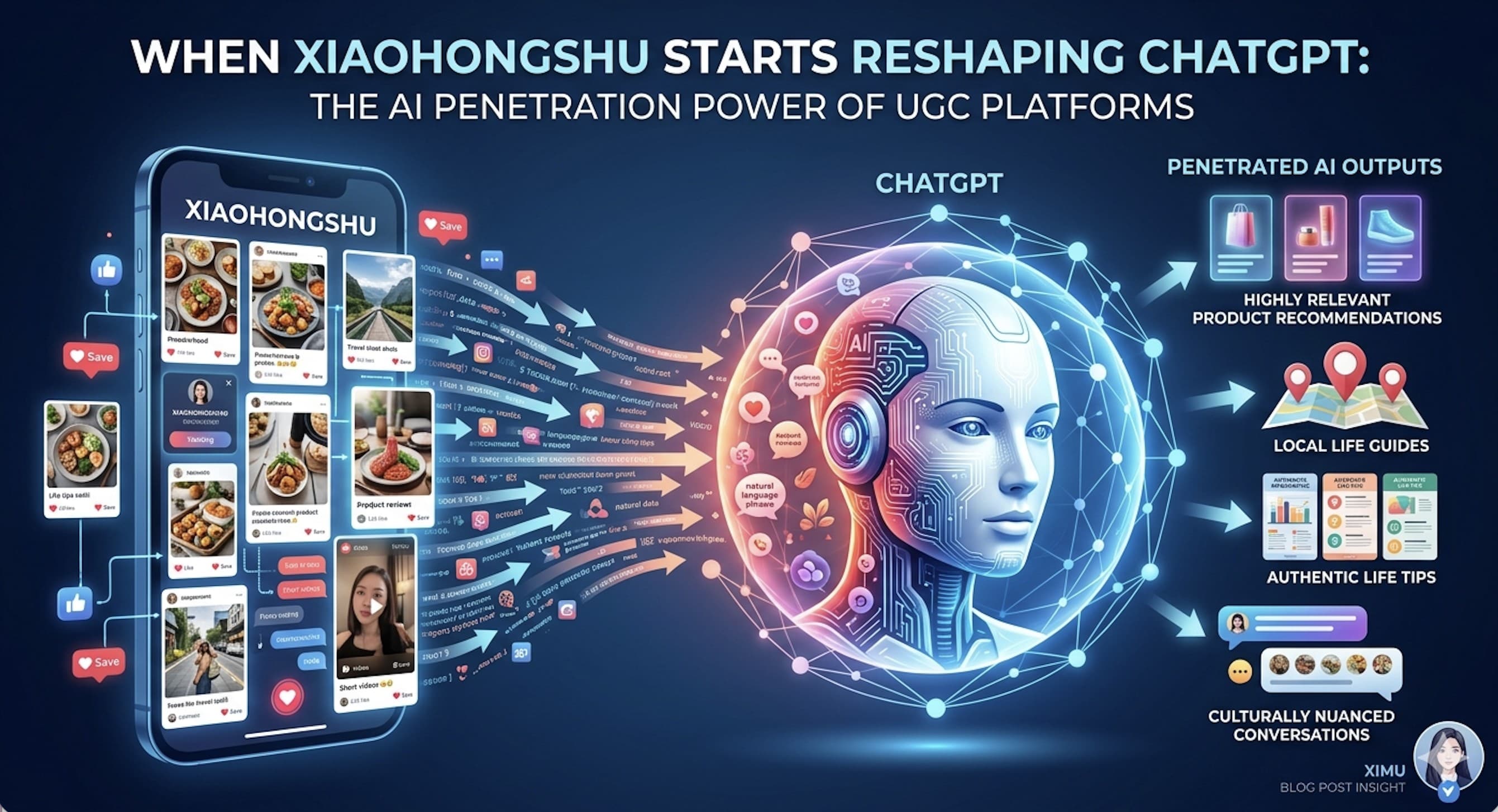
When Xiaohongshu Starts Reshaping ChatGPT: The AI Penetration Power of UGC Platforms
You Think You're Seeding Content. You're Actually Training the Model.
Open ChatGPT. Ask it: "Where should I take my kid for a weekend in Shanghai?"
It will hand you a clean, well-structured list. Locations, transit, restaurants, things to watch out for, even a backup plan if it rains. It reads like advice from a local friend who knows the ropes.
But have you ever stopped to ask—where does it know all this from?
Not Disney's official site. Not Ctrip. Not Dianping. It's Xiaohongshu. It's a note some mom posted two years ago, with weather tips, parking advice, and the pitfalls she stepped into on the ground.
The model never tells you who it read. But its answers have a texture. And that texture is the texture of UGC.
The Mirror Overseas: Reddit Has Already Walked This Road
If you want to see this clearly, the fastest way is to look West.
Over the past year, one of the biggest topics in the overseas GEO space has been the shifting share of Reddit citations inside ChatGPT. Semrush data shows that in early August 2025, nearly 60% of ChatGPT responses cited Reddit. By mid-September, that number had collapsed to around 10%. Ahrefs went deeper and found that Reddit pages were frequently retrieved by ChatGPT, but only 1.93% were actually cited in the visible response.
This isn't Reddit losing relevance. This is LLM providers actively rebalancing their source weights.
But even after that volatility, Profound's analysis of over 4 billion AI citations still arrived at the same conclusion—Reddit remains the single most-cited domain across answer engines. Inside ChatGPT, Reddit and Wikipedia hold first and second place. One supplies the what. The other supplies the so what.
And the most damning number is this: AmICited's research shows that roughly 91% of citations in AI responses come from third-party sources, while only 9% come from brand-owned websites.
That number should make every marketing lead still optimizing their corporate landing page break out in a cold sweat.
The model doesn't read your website. The model reads what other people are saying about you in communities.
This Isn't a Platform War. It's a Power Shift Around "Authenticity."
Why do LLMs prefer UGC?
Because what models lack has never been facts. Facts are everywhere. What models lack is friction—a real person, in a real situation, hitting a real problem, leaving behind a real solution.
That kind of content cannot be written by corporate websites. Not by press releases. Definitely not by SEO blogs. It only grows inside communities, inside that "I stepped into this same trap" kind of conversation.
LLMs know this. So they treat UGC platforms as a compressed database of human experience. They use Wikipedia to verify facts. They use Reddit—or Xiaohongshu—to verify what real humans actually think.
When an answer engine has to respond to "Is this product really worth it?" or "Does anyone actually like using this?", it doesn't go pull the "Five Key Advantages" page from the brand site. It goes pull a complaint someone wrote at two in the morning.
This is where UGC platforms derive their penetrative power into LLMs—they hold the one resource models lack the most: unpolished human feedback.
In Greater China, That Position Belongs to Xiaohongshu
Move the same logic into the Chinese-speaking world, and the answer is almost written on the wall.
Xiaohongshu's daily search volume hit nearly 600 million by Q4 2024—double its mid-2023 numbers. Monthly active users surpass 330 million. Coverage spans beauty, fashion, travel, parenting, renting apartments, finding a tax attorney, finding an accountant, finding a doctor.
It is no longer "China's Instagram." It is China's decision engine.
A single weekend-with-kids note about Shanghai might bundle together weather advice, subway routes, restaurant budgets, activity schedules, and a contingency plan for rain. One user spends an afternoon writing it, and the information density beats any travel website out there.
And right now, this content is leaking into LLM responses through several channels:
Channel one: training corpora. Public Xiaohongshu content gets swept up by crawlers like Common Crawl into general-purpose training data. GPT, Claude, Gemini—every major foundation model has, to varying degrees, ingested it.
Channel two: real-time retrieval . When a user asks ChatGPT a lifestyle question, the model fires off live web searches. Those results frequently include Xiaohongshu screenshots, transcriptions, and second-hand reposts.
Channel three: user prompts themselves. A growing user habit is "search Xiaohongshu first, then paste it into ChatGPT to summarize." In that workflow, Xiaohongshu's perspectives, phrasing, and recommendation logic get actively fed into the model's context window by the human user.
Channel four: the platform's own AI exit. Xiaohongshu has built its own AI search product called Diandian, designed around UGC sources, real-time information, and comment comprehension. This means Xiaohongshu is converting itself from "a platform that gets searched" into "an engine that delivers answers."
Add up the four channels, and Xiaohongshu has completed an identity shift—from a content-seeding platform into a memory layer for the model.
But This Penetrative Power Cuts Both Ways
This is where brands need to pay close attention.
Xiaohongshu's content ecosystem has long struggled with three problems: rampant disguised advertising, AIGC content flooding, and the difficulty of verifying source authenticity. Mainland China's "March 15 Gala" recently exposed what's been called "poisoned GEO"—mass-produced content engineered to mislead AI systems into making incorrect judgments.
This is not a technical issue. This is trust contamination.
When Xiaohongshu content starts reshaping ChatGPT, it doesn't just mean "good content gets cited." It also means bad content gets cited.
Your competitor has 200 paid notes on Xiaohongshu claiming your product "has side effects," "has terrible service," "is overpriced compared to theirs"—all of that flows into the model. The model can't distinguish between a real user and a hired writer. It only sees that "multiple independent sources describe it the same way."
So when a user asks ChatGPT "Is Brand A or Brand B better?", ChatGPT will calmly reply: "Based on online discussions, Brand A has some quality concerns."
That sentence wasn't ChatGPT's idea. That sentence came from a Xiaohongshu post written a year ago.
The model has no malice. The model is just relaying what it has read.
So What's the Real Question
It's not "should I be on Xiaohongshu."
That question should have been answered ten years ago.
The real questions are these three:
One: On Xiaohongshu, are you being seen by humans, or understood by models? A high-emotion viral post works on human users but reads as noise to a model. A note with clear structure, concrete scenarios, and authentic dialogue is the kind of content models are willing to actually absorb.
Two: Can you see how the model is describing you? Most brands have no idea how ChatGPT introduces them, and even less idea why AI keeps recommending competitors over them. This blind spot is ten times worse than the SEO blind spot—because it's invisible, with no SERP to check.
Three: When UGC platform content flows into the model, how do you ensure the model's "memory" of you is correct? This is no longer a content-production problem. This is a brand semantic governance problem.
The Next Battlefield Isn't Xiaohongshu. It's How Xiaohongshu Gets Read by the Model.
Back to the question we opened with—you ask ChatGPT about a weekend with your kid in Shanghai.
The answer the model hands you sits on top of a long chain of choices you cannot see: which sources got retrieved, which got cited, which got rewritten, which got discarded. There is no human editor in this process. No SEO ranking. No ad slot.
There is only one cold fact: Whoever the model understands, exists. Whoever the model does not understand, disappears.
Xiaohongshu's rise is not a social media story. It is a story about the restructuring of AI source authority. Its trajectory will look very much like Reddit's—becoming the data layer that models depend on the most, and worry about the most.
For brands, this means one thing: every dollar you have spent on Xiaohongshu, from this moment on, is no longer just a dollar spent on users—it is a dollar spent on the model. And the dollar you have never spent before, and don't yet know how to spend, is called brand semantic governance inside AI.
That is the new battlefield.
And the first step on that battlefield is to see how the model is currently seeing you.