Black Friday’s Toughest Competition Is Happening on a New Battlefield
Every Black Friday, the same metrics dominate the post-mortem: how much traffic grew, how expensive clicks became, and whether conversion improved.
This year, there is a new number on the agenda: how much traffic AI is sending to retail websites.
It deserves attention. But if the only lesson brands take from this Black Friday is that “AI traffic is growing,” they will miss the more consequential shift. What is changing competitive position is not simply where traffic comes from. It is who writes the shopping list.
That list used to form gradually in the consumer’s mind: scanning search results, reading reviews, comparing prices, and encountering a few well-timed ads. Now, a growing number of shoppers tell AI their budget, use case and preferences before visiting a single retail site—and receive a curated answer in return.
By the time the first click happens, many brands have already made the shortlist. Others have already been left out.
That is the change I most want to discuss this Black Friday.
1. AI referral traffic is real—but it is not the whole story
AI-assisted shopping has moved well beyond the demo stage. McKinsey’s October 2026 report, Who wins when AI does the shopping?, surveyed approximately 21,000 consumers across 11 countries. Over the previous three months, 53% of respondents had used AI for at least one shopping task. Among AI users, 14% had already completed a purchase directly through an AI tool—equivalent to roughly 9% of all respondents.
AI has clearly reached the transaction. But asking AI for advice and handing it the authority to buy remain two very different behaviors.
Transaction data adds another important signal. Drawing on more than one trillion visits to US retail websites, 100 million SKUs and 18 product categories, Adobe’s analysis shows that AI-referred traffic grew 71% year over year in September 2026. Those visitors converted 90% better than other traffic and generated 83% more revenue per visit, while also spending more time on site, viewing more pages and adding more products to cart. Adobe also forecast 95% year-over-year growth in AI referrals on Black Friday itself.
Read together, these figures invite an optimistic conclusion: AI has become a high-converting channel, and brands should immediately shift more budget toward it.
I would be cautious about defining it that quickly.
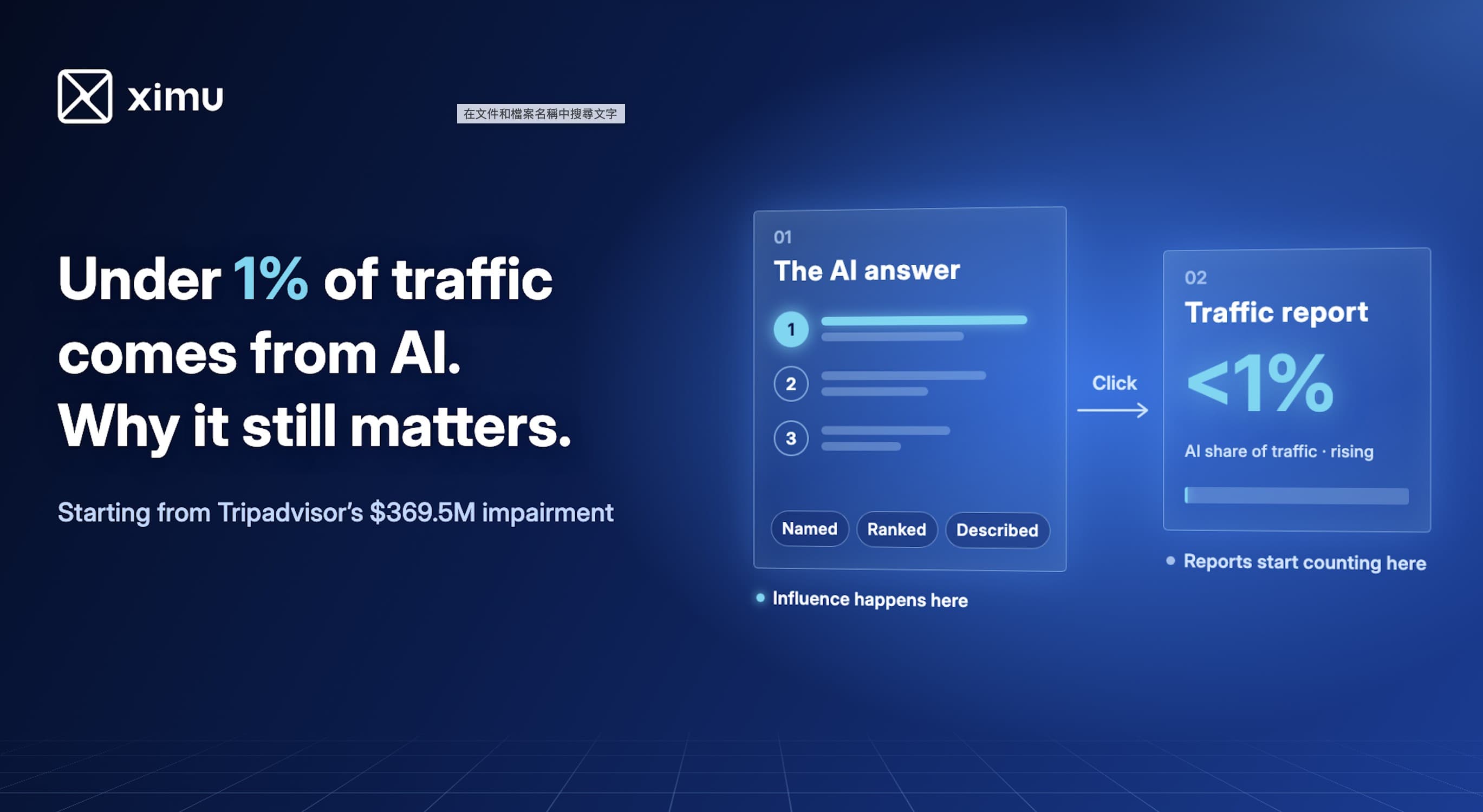
The 95% figure was a pre-event forecast, not a measured result. Adobe’s data captures visits after a shopper clicks a link in an AI answer; it cannot capture people who read an answer, never click, and still change what they buy. The evidence demonstrates the commercial value of AI referral traffic. It does not prove that all AI traffic converts better, and it certainly does not represent AI’s full influence on purchasing.
Even so, one conclusion is already solid: AI is no longer a trend to observe from a distance. It is participating in the business outcome.
The more important question is this: before those high-intent visitors arrive, which brands has AI already filtered out?
2. The shopping list is being written before the click
Consumers used to do the research themselves: understand the need, screen the products, compare the brands and decide who deserved a place on the shortlist. AI has now taken over a meaningful share of that work.
In McKinsey’s survey, 81% of AI shopping users said it helped them narrow their options, 80% said it reduced repetitive browsing and clicking, and 79% said it saved them significant time.
For consumers, the benefit is lower research cost. For brands, it means the competitive battlefield has moved upstream.
We used to talk about being seen in search results and advertising placements. Now we have to ask an earlier question: when AI compresses dozens of options into a handful of answers, why should our brand remain among them?
Product specifications, price, availability, use cases, customer reviews, expert evaluations, service terms and return policies can all inform the answer AI constructs. Black Friday makes this especially important. Shoppers care not only about the size of a discount, but also whether the offer is genuine, whether the price is truly competitive, and whether the product deserves a dedicated purchase.
Publishing a promotion does not mean AI will treat it as a credible reason to buy.
Brands therefore need to manage more than their websites and campaign pages. They need an external body of evidence: how specialist media evaluate them, how users discuss them, how third-party platforms present their products, whether product facts remain consistent across sources, and whether AI can read that information accurately.
Being mentioned by AI may create exposure. Being recommended puts a brand into the consideration set. And whether the recommendation is based on an accurate understanding determines whether it builds trust—or creates a new misunderstanding.
In the AI era, the shelf exists not only on ecommerce platforms, but also in the body of evidence AI uses to assemble its answers.
3. Consumers have not abandoned old channels; they have moved judgment upstream
At this point, it is easy to swing to another extreme: if AI is already filtering and recommending, must search, advertising, social media and physical retail all step aside?
Current consumer behavior does not support that conclusion.
A Gartner survey of 1,004 US consumers in August 2026 found that 34% were willing to use generative AI for holiday gift recommendations. But another finding is just as revealing: consumers using AI for shopping inspiration consulted an average of 4.48 information sources, compared with 3.24 among those not using AI.
AI has not reduced the number of channels consumers use. It has increased the information they consult before making a decision. Retailer websites, traditional search, recommendations from friends and family, Amazon and physical stores all remain important to discovery and purchase.
Deloitte’s 2026 holiday survey of 4,000 US consumers offers a useful contrast: 39% of respondents had made generative AI their primary tool for at least one holiday shopping task, but only 16% were willing to let it complete a purchase directly.
Consumers will delegate discovery, research, comparison and selection. The final decision to spend money is something most still want to keep in their own hands.
Taken together, these studies do not show AI replacing established channels. They show a journey being reorganized: advertising creates interest, AI narrows the options, search and brand websites support verification, media and word of mouth build trust, and ecommerce platforms complete the transaction. The order is not fixed, and each stage can feed back into the others.
AI is not the end of the shopping journey. It is becoming a decision layer that reorganizes the entire journey.
That is why focusing solely on AI referrals—or attributing everything to the last click—misses how consumers actually decide.
4. What brands need is not another AI dashboard
Marketing has long been managed channel by channel. Advertising teams track acquisition costs and conversion. SEO teams track rankings and organic traffic. Social teams track conversation and engagement. PR teams track coverage and reputation. Each function appears to have a complete answer of its own.
Once AI enters the shopping decision, those answers begin to diverge.
A brand may increase advertising spend without knowing whether its AI recommendations improve. A product topic may surge on social media without the brand knowing whether AI has begun citing the discussion. Website traffic may look stable while competitors quietly replace the brand in high-value shopping scenarios.
Viewed in isolation, any dataset can be locally correct and globally misleading.
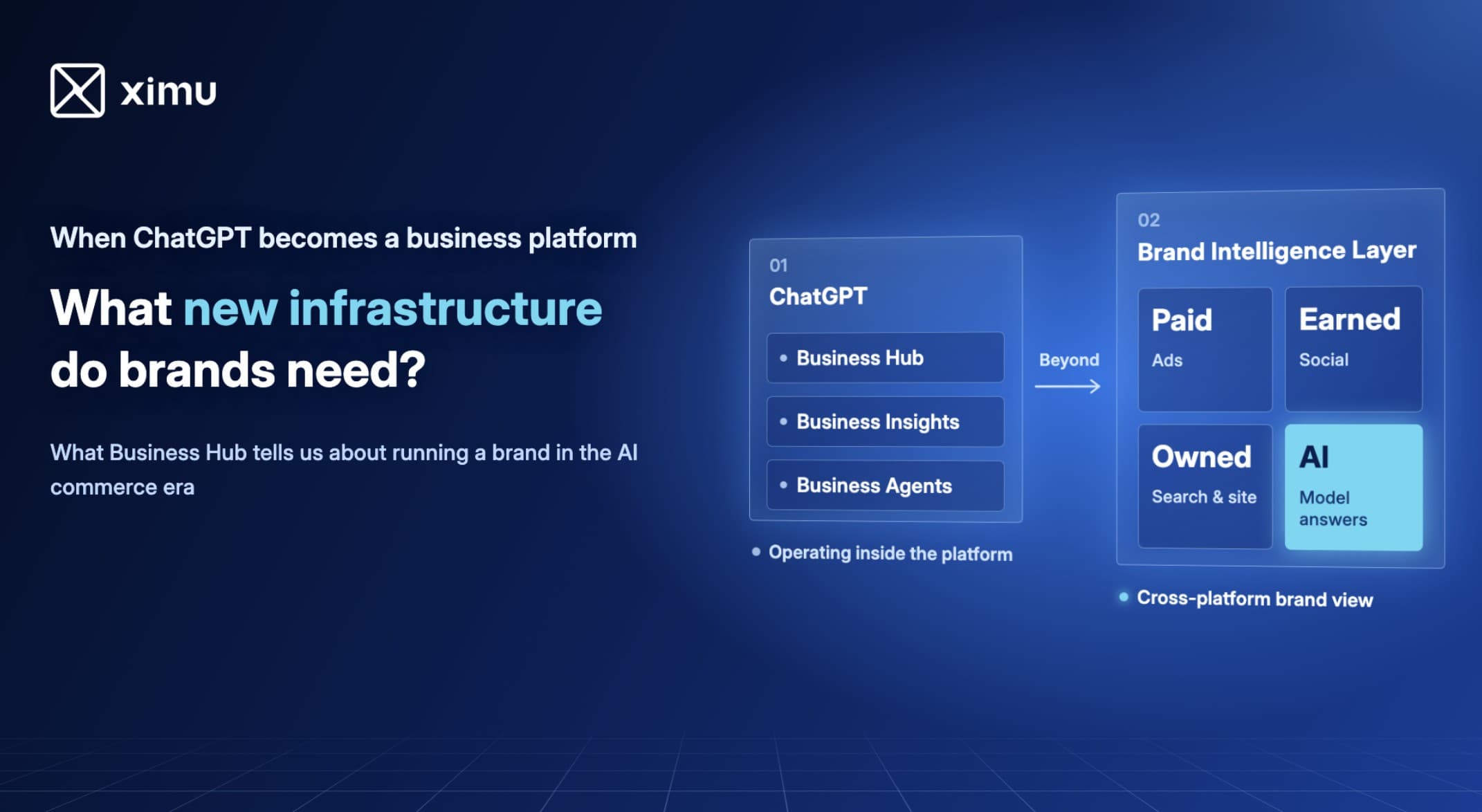
I believe four types of signals now need to be understood together: Paid, for media investment; Owned, for websites, product information and SEO; Earned, for media coverage, customer reviews and social listening; and AI, for visibility, citation, understanding and recommendation across models.
Putting them on one dashboard, however, does not complete the job. More advertising does not automatically produce more AI recommendations, and more social conversation does not necessarily produce more sales. The valuable work is to compare these signals continuously and validate them against site behavior, customer data and transaction outcomes—gradually learning which changes explain which results.
The goal of cross-channel intelligence is not a more attractive dashboard. It is less organizational isolation.
5. This is also why ximu is moving to its next chapter
Over the past year, ximu has continuously observed nearly 200 brands across Asia-Pacific, covering close to 100,000 business-intent queries in sectors including semiconductors, automotive, financial services, healthcare, consumer goods, beauty, and mother and baby products.
This is not a consumer sample or a log of real platform queries, and we do not present it as market share. It is better understood as a standing observation window: we design questions around commercial intent and watch, over time, how AI understands, cites, compares and recommends brands.
The longer we observe, the more convinced I become that mention count is only the surface. The same brand can receive different visibility, recommendation positions and source treatments when the model, market language or commercial scenario changes. A mention is not a recommendation, and a recommendation does not necessarily mean AI has understood the product’s real strengths.
What companies really need to know is when AI thinks of them, what information it uses to understand them, why it chooses a competitor in a side-by-side comparison, and which external signals shape those judgments.
ximu began with AI brand visibility and citation monitoring. Building on our SEO and website analytics capabilities, we are now integrating advertising performance and social listening data. Our goal is to bring AI, search, advertising, media and social conversation into one brand intelligence framework—so companies can see not only what happened in each channel, but also how the signals relate and what deserves attention first.
The next step is Commerce Agent: cross-data diagnosis, prioritization, recommended actions and outcome validation, turning fragmented marketing data into executable commercial judgment.
For VM, this also expands the value of PR. Media coverage, expert reviews, third-party content and genuine customer advocacy used to shape human awareness and trust. Today, they also become external evidence through which AI understands brands and supports recommendations.
Future brand communication must withstand human judgment—and AI’s reading, citation and verification.
What remains after Black Friday
The promotional window will close. Consumers will continue researching products, comparing brands and validating information all year. AI will continue answering those questions all year as well.
Adding content and updating campaign pages only during the shopping season may support a short-term push, but it cannot build lasting brand understanding and trust. What companies need to manage is an asset that keeps the brand accurate, consistent and credible across information environments—and eligible for AI recommendation over time.
On the surface, Black Friday is a contest for traffic. Underneath, it is becoming a contest for a place on AI’s shopping list.
More important than being mentioned during one promotional season is having a reason to be understood, trusted and recommended whenever a consumer begins a serious comparison.
That is the new capability brand management requires in the AI era. It is also why ximu is moving from GEO monitoring to cross-channel Brand Intelligence, and then to Commerce Intelligence.