When LLMs Treat Outdated Negative News as Fact: PR Crises in the AI Era
The Crisis Is Already Happening — Brands Just Can't See It
If you opened ChatGPT today and asked, "I'm considering working with Company X — are they trustworthy?" what would you get back?
Most likely, a measured, balanced response citing multiple sources. It sounds fair. But buried inside might be a sentence like this: "The company faced media scrutiny several years ago over a controversy that raised consumer concerns."
To the AI, that's just a retrieved factual statement. To the brand, that controversy may have long since blown over — officially clarified, internally addressed, and put to rest.
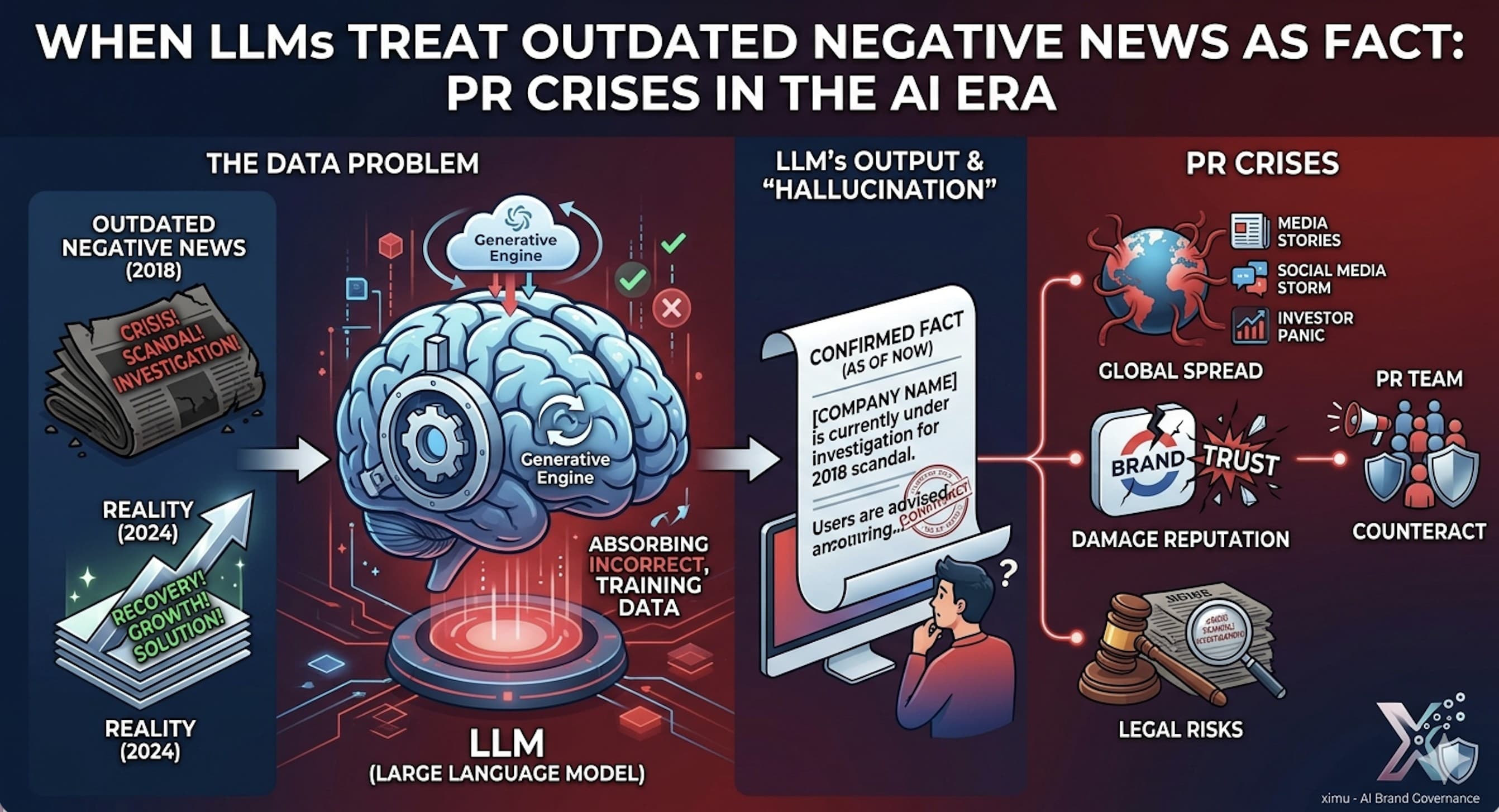
The problem is this: the version the AI knows is frozen at the moment the controversy broke.
The conversation ends. The customer doesn't follow up, doesn't call to verify — they may simply walk away from the deal. The brand never gets a notification. There's no trending hashtag. The crisis happens silently, in the single moment the model generates its answer.
For over a decade, PR crisis management has rested on one assumption: incidents are observable. News stories make headlines, social conversations build heat, Google rankings shift in detectable ways. These are signals brands can monitor and act on. Generative AI breaks that assumption. When an LLM stitches together scattered old reports, old comments, and old data into a single seemingly objective answer, that answer doesn't show up in any monitoring dashboard.
In other words, the PR challenge of the AI era isn't that crises are more frequent. It's that a whole class of crises has become invisible.
Why LLMs Treat Outdated Negative News as Fact
This isn't a bug. It's the result of several structural mechanisms compounding on each other.
First, the training data cutoff. Every major LLM has a date beyond which its training data simply ends. Anything that happens after that — resolutions, retractions, clarifications, personnel changes — the model can't know. Even with periodic updates, the cycle still runs in quarters or years, more than enough time for outdated negatives to live on.
Second, negative content carries disproportionate weight in training corpora. A controversy gets picked up by multiple outlets, reposted on forums, cited by bloggers, debated on social media. Its "copy count" online dwarfs that of any subsequent clarification. When a language model sees the same event described over and over, it naturally treats it as high-confidence information. Put bluntly: scandals come with volume; clarifications come with silence. This isn't AI bias. The AI is faithfully mirroring an asymmetry that already exists in our information environment.
Third, retrieval-augmented generation (RAG) is no silver bullet. Many assume that connecting an LLM to live search solves the staleness problem. The reality is more complicated. RAG pipelines still depend on the ranking logic of search engines, and old negative news — by virtue of being widely reposted and richly backlinked — tends to rank high in search results. Even if a brand has issued a clarification since, that clarification's SEO weight rarely matches the original story. The AI gets fed the wrong baseline, and the answer it produces leans toward the older version.
Fourth, citation authority is misaligned. LLMs gravitate toward sources that "look authoritative" — major media, Wikipedia, well-known forums. But corporate statements, official press release platforms, and trade-specific publications often carry less weight in a model's eyes than a widely syndicated exposé. The result: even when a brand does the right thing, the records of those right actions don't necessarily make it into the AI's citation hierarchy.
Put these four together and the picture is clear: this isn't AI breaking. This is AI faithfully reflecting an information ecosystem that was already asymmetric to begin with.
Four Common Crisis Patterns
In real consulting cases, this kind of "AI cognitive drift" tends to show up in a few recurring shapes.
Pattern 1: Resolved past disputes that keep getting cited. A once-prominent legal dispute or public controversy has long since wound down, with the company having quietly moved past it. But the model still flags it as a brand risk. The impact on B2B sales, fundraising, and partnership conversations is direct and immediate — when the other side does due diligence, the first thing they ask the AI is often, "Does this company have any red flags?"
Pattern 2: Old defects in discontinued products. A particular product line had quality issues years ago. The company pulled it, fixed it, and shipped a better version. But when asked about the brand, the AI still lists those old defects as "common issues with this brand." Consumers don't know it's about a discontinued model — what they walk away with is the impression that the brand has quality problems.
Pattern 3: Past controversies involving founders or executives. The individual in question may have moved on, switched industries, or even sold the company. But the model, when describing the company, still ties old personal controversies to the current organization. The damage here is slow and persistent — it surfaces every single time the AI introduces this company in conversation.
Pattern 4: Competitor manipulation and information contamination. A more active threat than the previous three. Through mass-produced low-quality content, manipulated citation sources, and plausible-looking comparison reviews, bad actors can systematically influence how AI judges a brand. OpenAI has long noted in its safety research that generative systems are inherently vulnerable to data poisoning and prompt injection. When these techniques get industrialized and scaled, "how AI sees you" stops being something that forms passively and becomes something actively shaped by others.
Why Traditional PR Tactics Fall Short Here
Faced with these scenarios, most companies fall back on a familiar crisis playbook: issue a statement, brief the press, push out a release, send legal letters to demand takedowns where needed. These tactics work in traditional media. In the AI era, they hit structural limits.
A statement works on people, not on models. A model doesn't update its answer tomorrow because you issued a clarification today — its weights have already been shaped by years of accumulated information, and one new release is a drop in the ocean. A legal letter can get a single site to take content down, but the content has long since been quoted, screenshotted, reposted, and absorbed into training corpora. Removing the source doesn't remove the trace it left in the model's memory. SEO suppression can push old news to page two of search results, but LLM citation logic isn't identical to search ranking — what ranks first isn't necessarily what the model picks up first.
This doesn't mean these tactics should be abandoned. On the contrary, they remain foundational engineering — there just needs to be a new layer built on top of that foundation.
From Issues Management to Cognition Governance: GEO Extends SEO, Not Replaces It
A line that's been making the rounds in the industry: "SEO is dead. GEO is the new game." We think this framing is too sharp, and risks pushing brands into the wrong resource allocation.
The more grounded view is this: GEO is a governance layer built on top of SEO. A large portion of what LLMs cite comes from content that's crawlable and structurally parseable — in other words, the entire information ecosystem that twenty years of SEO has built. If a brand's official information can't even be found on Google, expecting an AI to surface it as a "trusted source" is close to impossible. SEO puts the information on the table. GEO determines whether that information can be read, cited, and remembered correctly by AI.
Another way to put it:
- SEO governs the human search experience — keyword rankings, click-throughs, bounce rates.
- GEO governs being Seen & Trusted by Humans and AI — how a brand is simultaneously seen, understood, and trusted by both audiences.
The two stack. They don't substitute. A brand without solid SEO fundamentals trying to do GEO is building a tower with no foundation. A brand doing SEO without GEO has built the tower but never opened a window — AI can't get in, and nothing the brand has built gets carried out.
This also means PR work itself has to evolve from issues management to cognition governance. Issues management deals with events — what story broke, whether to respond, how to cool things down. Cognition governance deals with long-term state — how AI understands the brand overall, which version it cites, where it positions the brand relative to competitors, how deeply outdated information has seeped in. The first is reactive. The second is structural.
What Brands Need Isn't More Exposure — It's Correct Memory
Governing brand image in the AI era means the central question is no longer "how many times have I said it?" but "what does AI remember about me?" This is a fundamental shift from output to outcome.
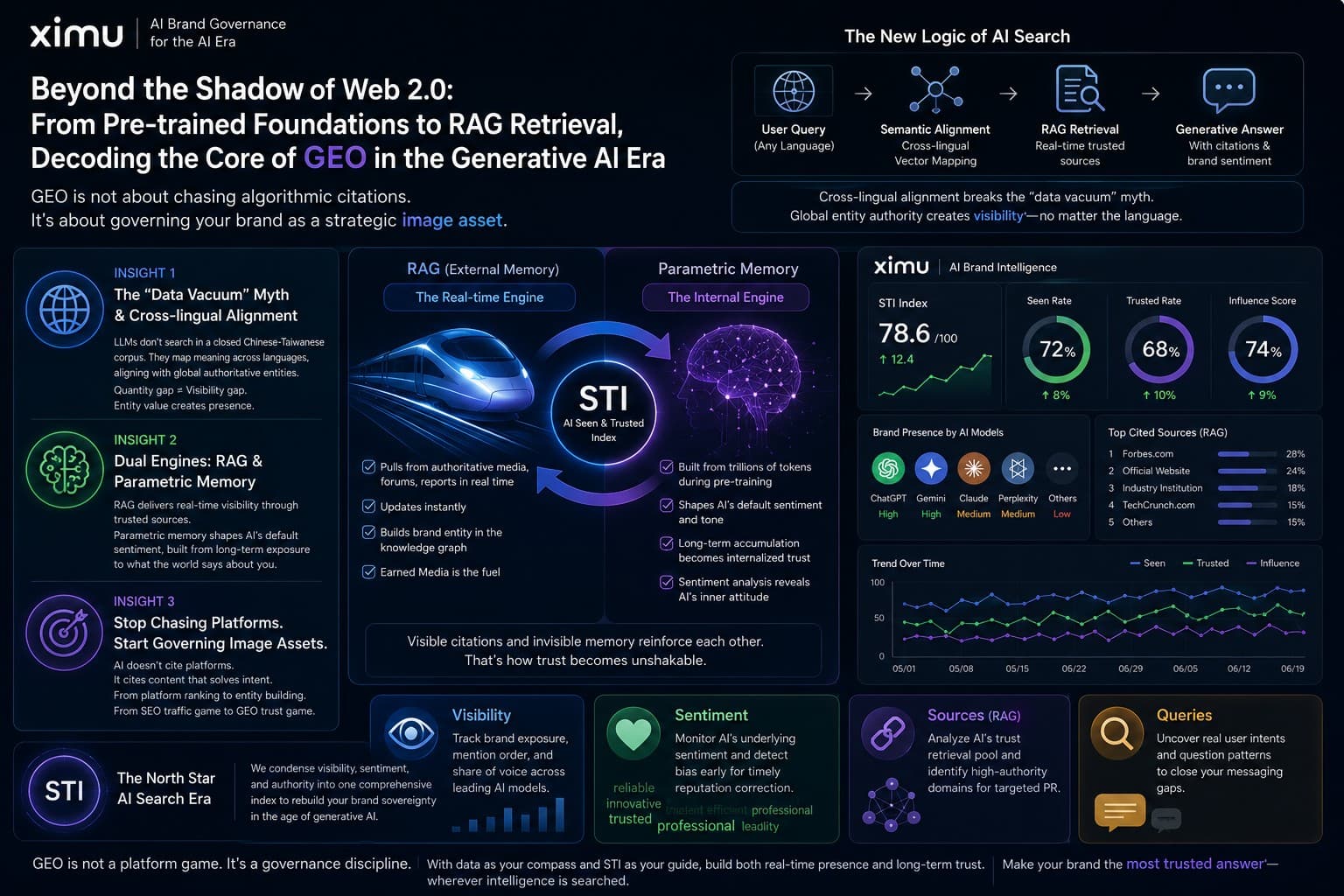
In ximu's methodology, that shift breaks down into three measurable indicators:
Visibility — When users ask AI questions related to your industry, category, or solution, how often does your brand show up, and where? Without visibility, nothing else matters — if the AI doesn't mention you, you don't exist.
Sentiment — When the AI does mention you, what's the tone? Positive, neutral, or negative? Are you being held up as a benchmark, or tied to a controversy? High visibility with negative sentiment is worse than no mention at all — it means the AI is actively retelling an unwanted version of your brand to every single person who asks.
STI (Seen & Trusted Index) — A composite indicator combining visibility and trust, reflecting the overall health of a brand in AI's cognitive system. It answers a single question: when AI is asked about your space, are you both seen and trusted? STI is ximu's core unit of measurement, designed to replace the legacy "impressions" mindset.
What makes outdated negative news so corrosive is precisely that it damages all three at once — letting an incorrect version occupy your visibility, dragging down your sentiment, and ultimately pulling down your STI. Conventional crisis response can only handle the moment of the incident. It has no answer for this kind of long-running, chronic, slow-seeping cognitive contamination.
ximu: Making the Brand Inside the Model Visible and Governable
ximu is the AI-native platform built to answer exactly this problem. What it does is simple and essential: let brands see how AI actually understands them.
Through Visibility, Sentiment, and STI — paired with cross-model citation source tracking, semantic positioning analysis, and competitor benchmarking — ximu turns the previously vague notion of "brand impression" into a quantifiable, comparable, continuously optimizable data asset. When an outdated negative gets repeatedly cited on a particular platform, ximu surfaces it. When a competitor systematically out-appears you on a given prompt category, ximu surfaces it. When your official messaging is being outranked by secondary sources in AI citation weighting, ximu surfaces that too.
From that point forward, outdated negative news stops being an invisible crisis the brand can neither see nor address. It becomes something nameable, locatable, and actionable. The traditional capability to manage events isn't replaced — it just finally has the partner it was missing: a mirror that continuously sees inside the model.
Closing
The hardest part of a PR crisis in the AI era isn't its intensity. It's its quietness. It doesn't make headlines, doesn't blow up on social, doesn't trigger legal calls. It just shows up — calmly, objectively, articulately — every time someone asks an AI about your brand, telling a version you've long since corrected but the model still remembers.
The only thing brands can do is see it first, then govern it.
Trust · Influence · Resonance — in an era where humans and AI together decide brand value, being seen is only the starting line. Being remembered correctly is where the race is actually won.