Real GEO Optimization Doesn't Begin with Action — It Begins with Seeing
Why ximu starts with monitoring and diagnosis, and how it becomes the brand-governance foundation for the AI era
Lately, an interesting pattern has emerged in the GEO market: among providers offering the same kind of GEO service, some keep quoting lower and lower prices, while others have started raising theirs — and clients are willing to pay.
On the surface, this looks like a difference in price. At its core, it's a difference in value.
When a service can't clearly answer "where the brand stands right now, what the problem is, what has improved, and how the results are verified," it ultimately has nothing to compete on but price.
But GEO shouldn't be about the number of content pieces, the volume of backlinks, or a checklist of deliverables.
What GEO truly deals with is a brand's Visibility, Trust, and Influence in the world of generative AI. In other words: whether the brand is seen by AI, whether it is correctly understood by AI, and whether it stands a chance of becoming the answer that AI prioritizes — the one it cites and recommends first.
And this is precisely why ximu exists.
We didn't start with "optimization." We started at the source of the market — with monitoring and diagnosis.
Because in the AI era, most companies have no idea what they actually look like inside AI.
The biggest problem with GEO isn't the absence of optimization — it's the absence of a baseline
When companies did SEO in the past, they could at least see their search rankings.
But in the AI era, brands face an entirely new question:
How does AI actually see me?
In which queries am I mentioned? In which questions do I disappear entirely? Which models recommend me? Which models lean toward my competitors? Which sources does AI cite? Are those sources trustworthy? Across different languages, markets, and models, is the brand's image consistent?
If there are no answers to these questions, then so-called GEO optimization is, in essence, just guesswork.
Today, when many companies hear about GEO, their first reaction tends to be:
Should I produce more content? Should I publish more press releases? Should I generate more exposure?
These can all be part of the solution.
But they shouldn't be the first step.
The first step should be seeing.
Because only by seeing can you know where the problem lies.
What ximu solves isn't a ranking problem — it's the problem of brand visibility in the AI world
In our conversations with companies, we've found that many brands are actually facing one of the following situations:
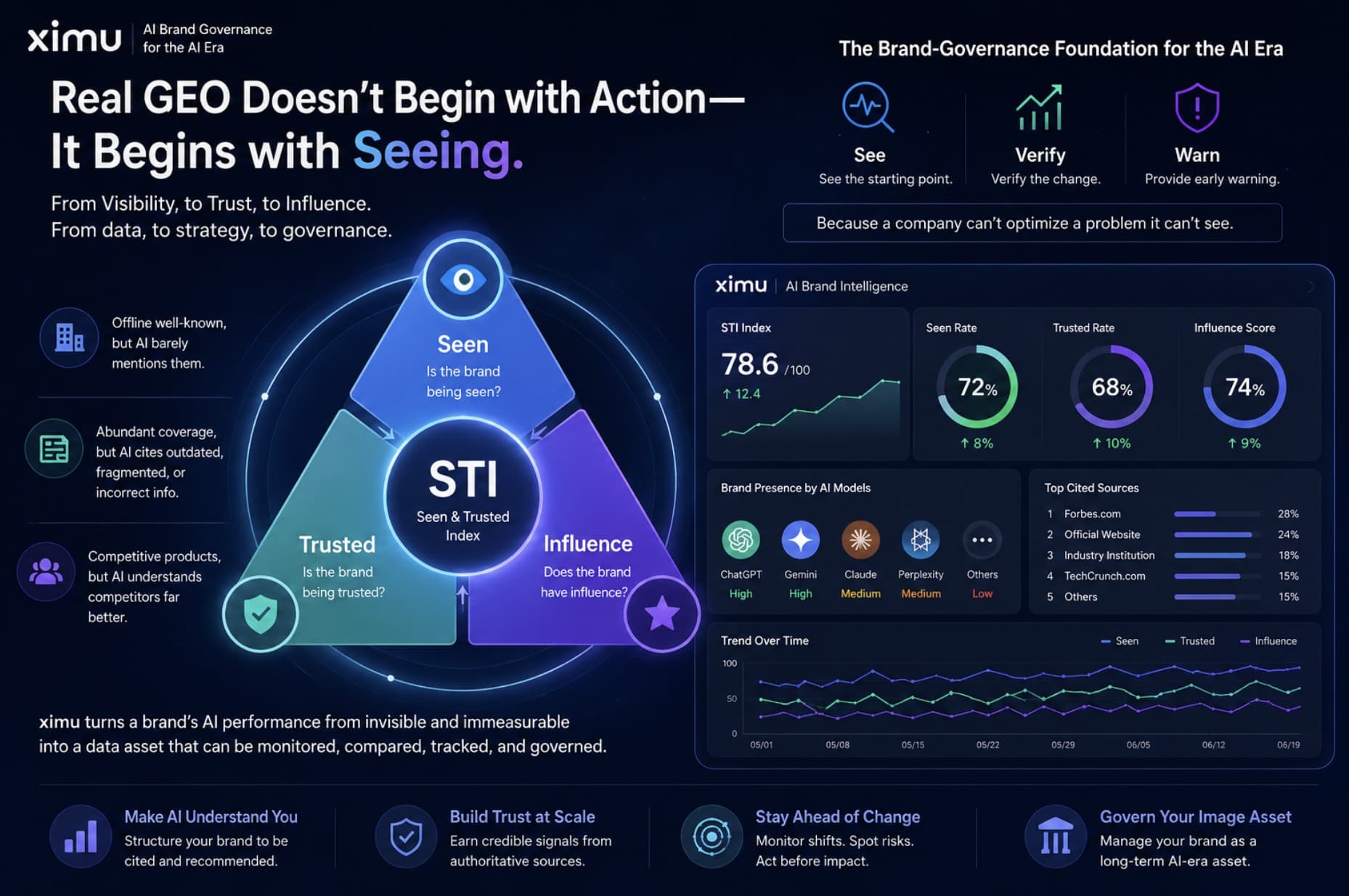
Some brands are extremely well known offline, yet AI barely mentions them.
Some brands have abundant media coverage, yet what AI cites is outdated, fragmented, or even incorrect information.
Some brands have products every bit as competitive as the market leader's, yet AI understands their competitors far better than it understands them.
Some brands pour large budgets into content, yet still can't establish a stable presence in AI's answers.
The problem often isn't that there isn't enough content.
It's that the brand lacks the structure to be understood, cited, and trusted by AI.
This is exactly the core problem ximu sets out to solve.
We transform a company's brand performance in the AI world — from an invisible, unmeasurable state — into a data asset that can be monitored, compared, tracked, and governed.
How does ximu measure a brand's performance inside AI?
If GEO is to become a genuine management tool for companies, it has to establish a shared language and shared metrics.
That's why ximu has built an AI brand-measurement framework centered on the STI Index (Seen & Trusted Index).
Seen | Is the brand being seen?
Does the brand appear in AI's answers?
Is its mention rate stable?
Does it have a presence in the queries that matter?
If a brand isn't being seen by AI at all, then no matter how good its products and services are, they can't enter the decision-making process.
Trusted | Is the brand being trusted?
When AI cites the brand, which sources is it drawing on?
Do those sources come from authoritative media, official websites, industry institutions, or credible third parties?
Is the brand being understood and described accurately?
Being seen doesn't mean being trusted.
What truly matters is whether the brand carries enough credible signals.
Real GEO isn't monitoring, and it isn't optimization — it's a governance capability
We've consistently emphasized:
Monitoring isn't all there is to GEO.
But without monitoring, there is no GEO.
Because a company can't optimize a problem it can't see.
Real GEO optimization requires at least three capabilities:
First, seeing the starting point.
Second, verifying change.
Third, providing early warning.
AI's answers aren't static pages — they're a semantic environment in constant flux.
A competitor's new content, the media's new reporting, the industry's new topics, a model's new preferences — any of these can shift a brand's position inside AI.
Without monitoring, a company can only explain things after the fact.
With monitoring, a company can manage things before they happen.
This is why we position ximu as the brand-governance foundation for the AI era — not merely a monitoring or optimization tool.
In the AI era, brands need more than exposure — they need to be understood
In the search era, brands pursued rankings.
In the AI era, brands pursue understanding.
If a company can't see what it looks like inside AI, it can't manage its image asset in the AI era.
This is exactly what ximu sets out to solve.
To let companies know whether they are being seen.
To let companies know whether they are being trusted.
To let companies know whether they hold influence.
From Visibility, to Trust, to Influence.
From data, to strategy, to governance.
This is more than GEO.
This is IMAGE Asset Governance for the AI era.