
To an AI, "Apple" and "AAPL" Aren't the Same Thing — On Normalization, the Precondition for AI Monitoring Data You Can Trust
Why simply counting how often you're mentioned is far harder than it sounds
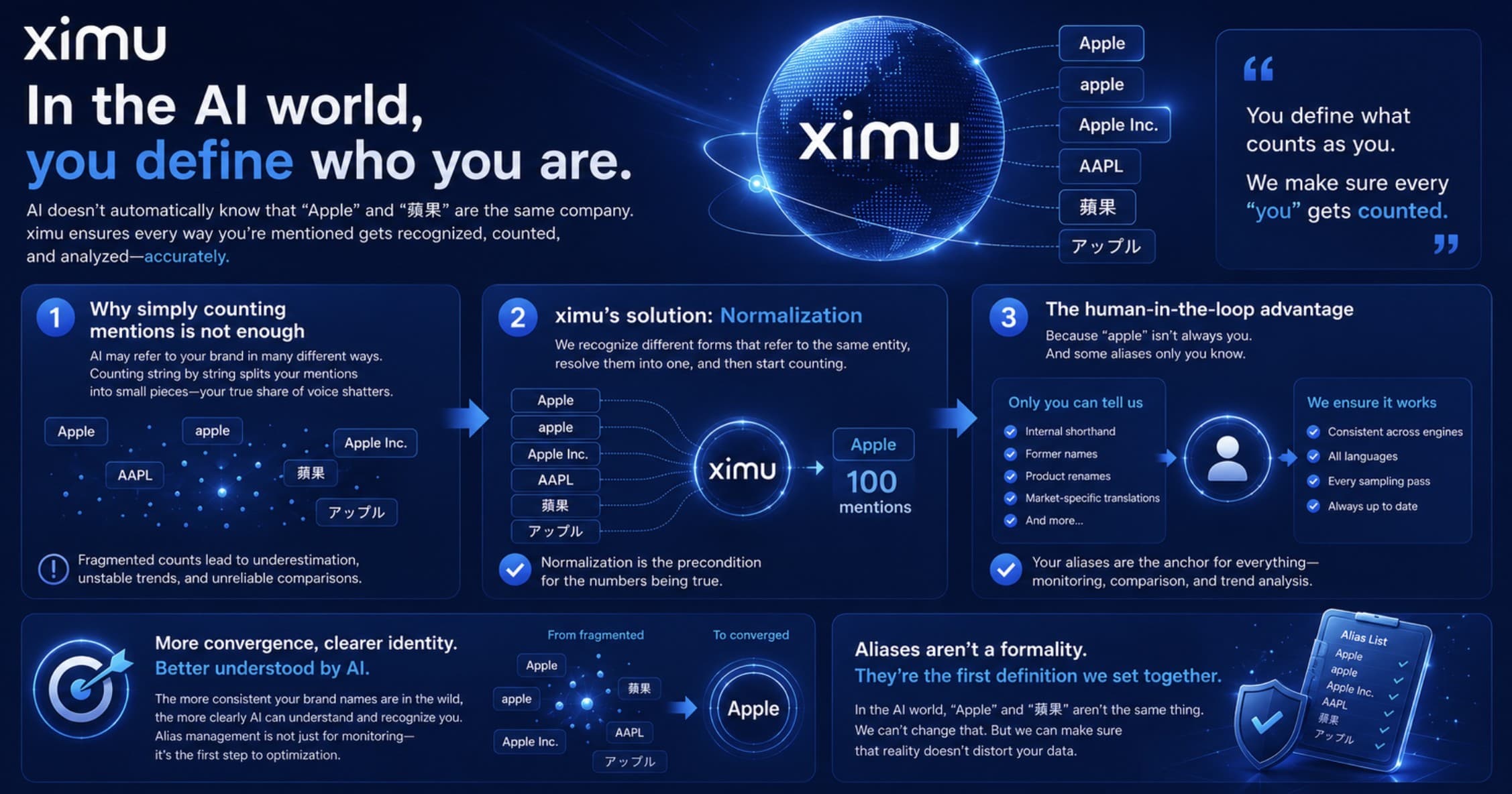
Apple. apple. Apple Inc. AAPL. 蘋果. アップル.
Every one of these points to the same company. You know that. I know that. The AI doesn't necessarily know that.
In an AI's output, "Apple" and "蘋果" aren't automatically treated as the same object. The moment the model writes one and the moment it writes the other don't know they're referring to the same thing.
Which leads to something genuinely strange: you set out to monitor "Apple," and a competitive breakdown surfaces a mention of "蘋果" — and the system has no idea that one is also you.
Count string by string, and your share of voice shatters
Monitoring a brand starts with one thing: counting every time the AI mentions you.
But run the same set of prompts a hundred times and the model may refer to you in five different forms. If the system dutifully counts string by string, your hundred mentions splinter into five small piles — each one, on its own, too small to rank, too small to make the report.
The fix is a step that has to happen before counting: recognize that "Apple," "apple," "Apple Inc.," and "AAPL" all point to one object, resolve them into that single entity, and only then start counting.
That step is called normalization.
It's something ximu does constantly under the hood — and something you never see directly in the report. What you see is a clean "mentioned 100 times." That 100 exists only because five different forms were pulled back together first.
Without this step, everything downstream distorts: visibility gets undercounted, trends jitter, comparisons against competitors stop holding up. Normalization isn't an advanced feature. It's the precondition for the numbers being true at all.
But there's one thing no machine, however clever, can do
If normalization were just "merge the strings that look alike," you could hand it entirely to the machine. So why ask a human to fill anything in?
Because the hard part isn't the merging. It's the judgment — and judgment is exactly where machines keep failing.
Because "apple" isn't always you. It might be the fruit. It might be a media outlet. Looking at the word alone, the system can't be sure this particular mention is your company. Merge it wrongly and your share of voice absorbs things that aren't yours — which is worse than undercounting, because you'll walk into a decision holding an inflated number.
And because some aliases only you know. An internal shorthand, a former name, a product line you just renamed, a translation used only in one market — none of these look like your brand name, and none appear in any public lookup table. A machine can handle "looks alike." It can't handle "only you know."
That's why the alias field is something you fill in yourself.
The aliases you enter are the anchor for the entire system
When you fill in your aliases, you're really telling the system one thing: what counts as you, and what doesn't.
These forms are all me → the system pulls them together, missing none. That identically-named thing isn't me → the system keeps it out, never charging it to your account.
No algorithm can derive this information; only you can supply it. It's the anchor for everything that follows — without it, none of the counting, comparison, or trend analysis can stand.
Our half is the other side: turning the aliases you give us into a mechanism that runs consistently across every engine, every language, and every sampling pass.
You define what counts as you. We make sure every "you" gets counted.
Neither half works alone. However good our normalization is, we can't guess the shorthand you use internally; and however complete your alias list, without a mechanism to enforce it, it's just a list lying flat on a page.
One more thing: the more care you put in, the sharper you look to an AI
That alias list is worth more than monitoring alone.
When you sit down and genuinely inventory how many ways you get referred to, you often notice something for the first time: out in the wild, your brand is fragmented — five forms all going their own way, none of them repeatedly, consistently bound together.
And an AI's understanding of a brand is built precisely from that source material. The more scattered your names, the blurrier the "you" in the model's mind; the more they converge, the more you resolve into a single, nameable object it can actually call up.
So filling in aliases points two directions at once: backward, it lays the foundation for monitoring; forward, it points at optimization — get your own names to converge first, and only then can the AI converge on you.
"Apple" and "蘋果" aren't the same thing to an AI. That's the reality, and we can't change it. What we can do is keep that reality from distorting your data.
The few minutes you spend filling in your aliases aren't a formality. They're the first definition you and we set down together — of who this brand is, inside the world of AI.