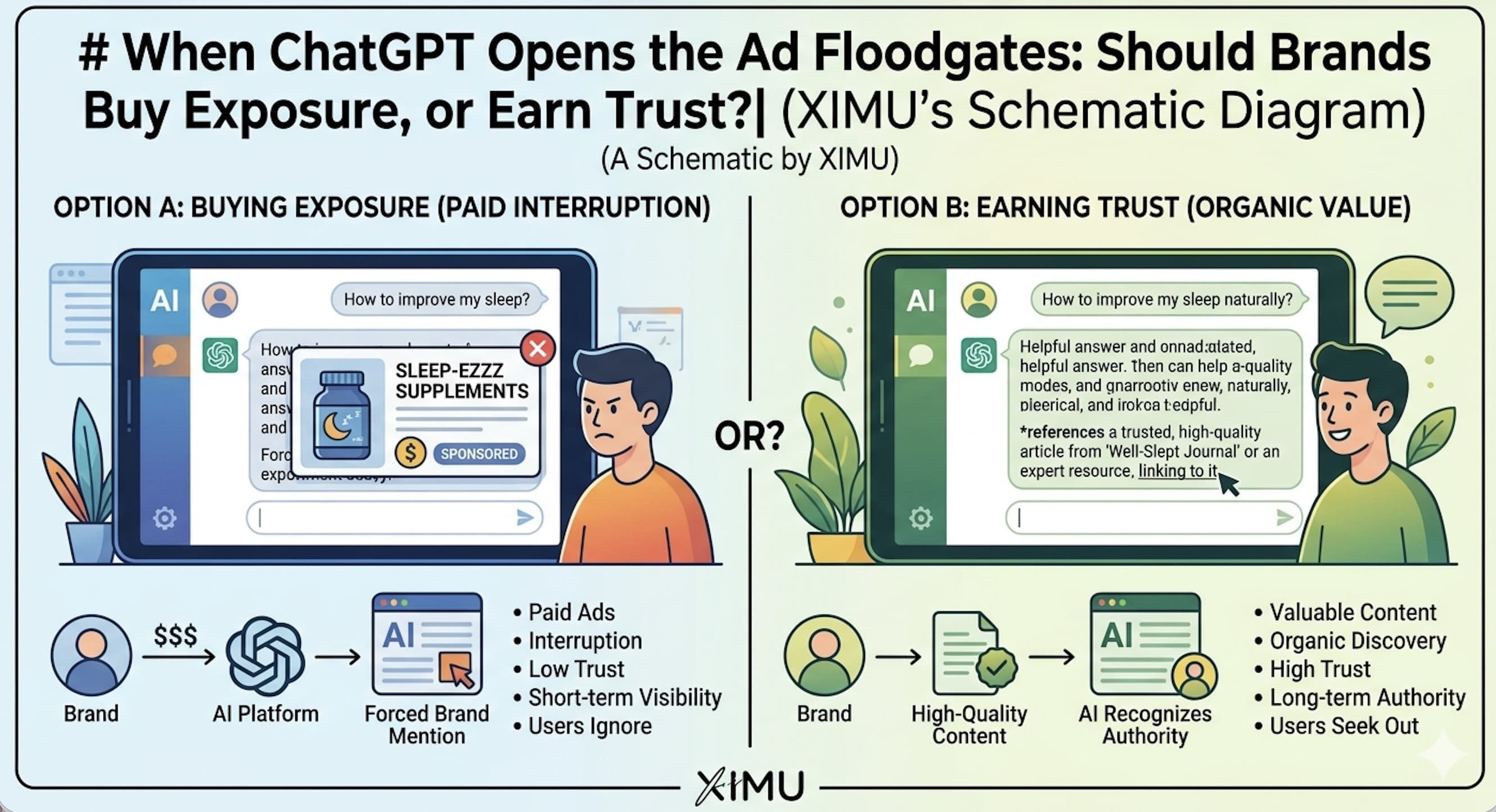
When ChatGPT Opens the Ad Floodgates: Should Brands Buy Exposure, or Earn Trust?
This is a watershed moment. OpenAI's full rollout of its advertising platform to enterprises worldwide is more than a commercial milestone — it marks a deep fracture in the AI industry's trajectory: AI products are now splitting into two distinct paths, attention monetization and productivity monetization.
In an era where ChatGPT's ad CPM runs as high as $60 — three times Meta's rate — we have to ask a hard question: where should brands place their growth bets? On expensive ad slots, or on the cognitive real estate inside the AI model itself?
Expensive Attention, and the "Invisible" Decision
OpenAI has chosen the gateway-product playbook, feeding its commercial engine with the traffic of 900 million weekly active users. But behind the $3–$5 cost-per-click lies an uncomfortable truth: advertising is, at its core, a tax brands pay for the right to be seen.
Even when ad modules are clearly labeled "Sponsored" and separated from the AI's actual response, the decision path itself has been fundamentally rewritten. In the old search era, users held the autonomy to choose which link to click on a SERP. In the AI era, that decision power has migrated inside the conversation window.
"Advertising is exposure you pay for. GEO is trust you earn."
When an AI assistant delivers a synthesized answer, the ad is reduced to a plug-in that appears after the answer is already given. For high-intent users seeking precise solutions, what truly drives the decision is the brand the model mentions in its answer, the data it cites, and the reasoning chain it constructs.
Why GEO and ximu Are the Higher-ROI Investment
Search volume is projected to drop by 25%. For brands obsessed with ad rankings while ignoring the cognitive gaps inside the model itself, the consequences will be fatal.
1. From "Exposure" to "Understanding": A Long-Term Cognitive Asset
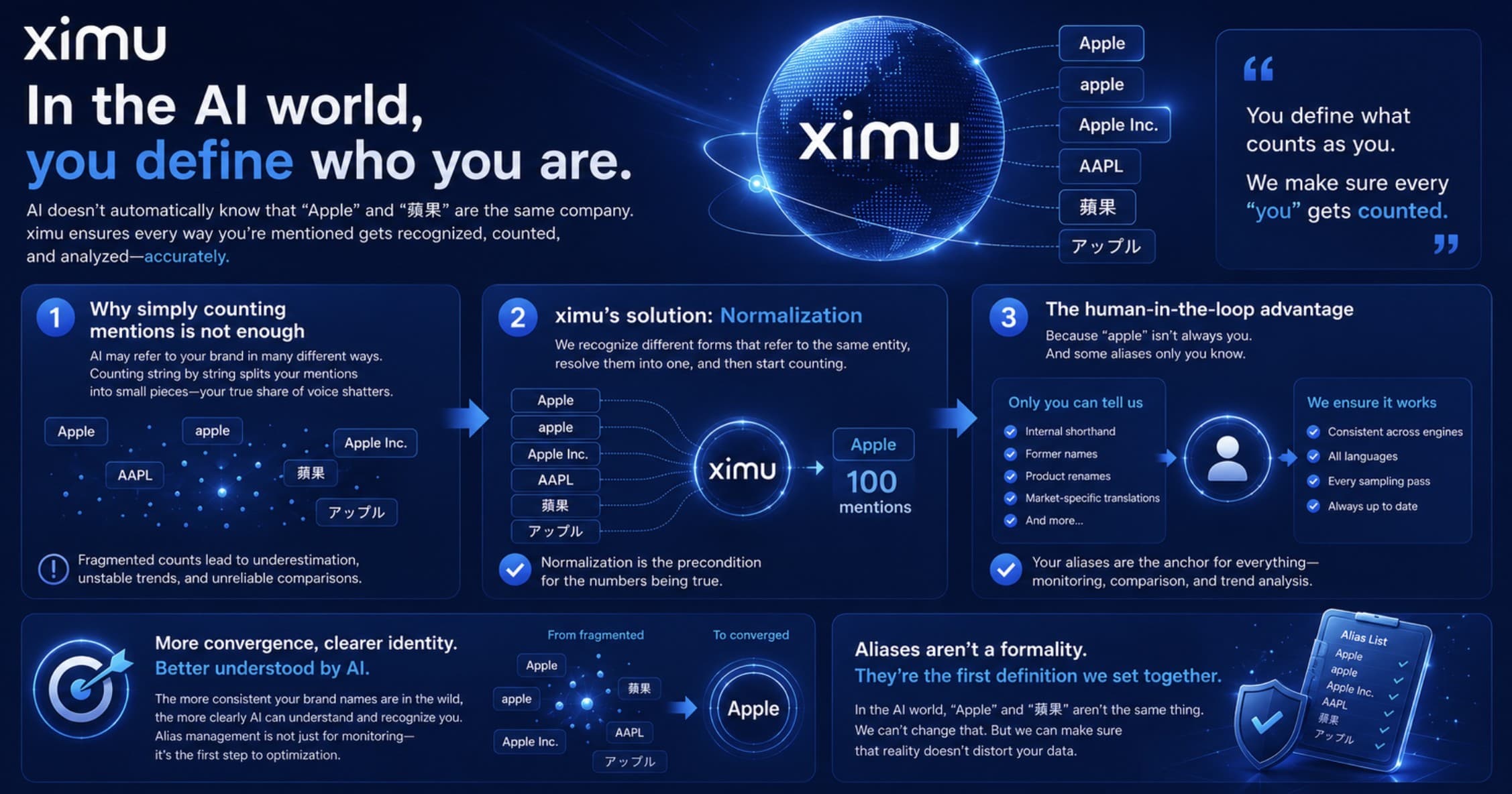
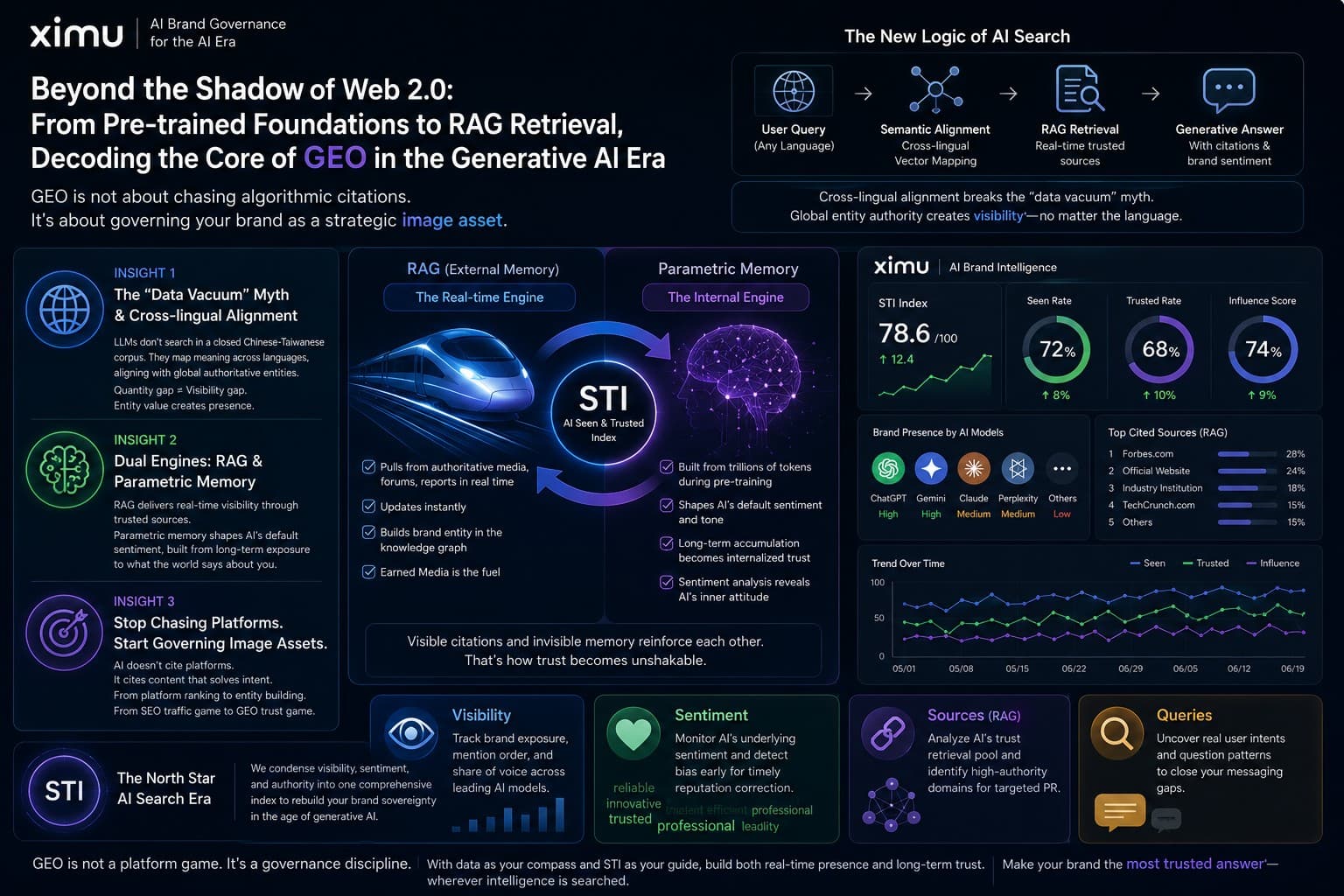
SEO is about being found — a game played with keywords and links. GEO is about being understood — a game played with entities and semantic relationships.
Through ximu and GEO governance, brands can transform fragmented information into Image Assets that are readable, credible, and citable by the model. Advertising is short-burst fuel; GEO builds the semantic bedrock of a brand. It is a long-term asset that does not vanish when the budget runs out — something short-term ad exposure can never deliver.
2. The Trust Moat in High-Barrier Industries
This matters even more in high-expertise sectors like healthcare and biopharma, where AI models apply extremely strict standards before they will cite a source. In these fields, consumers approach AI-generated content with caution and skepticism.
Pure ad spend cannot bridge this trust gap. Only through trust verification with ximu — ensuring brand content carries semantic consistency and authoritative endorsement — can a brand enter the AI's recommendation nodes.
3. A New Dimension of Cost-Efficiency
ChatGPT's $60 CPM is a direct drain on enterprise margins. GEO optimization, by contrast, is rooted in governance, not purchase. When a brand's Image Assets are indexed by AI and automatically surfaced as recommendations across multiple conversational contexts, the resulting organic traffic and decision weight far exceed what hard advertising can convert.
The Future Battlefield: Owning a Position Inside the Model
The launch of GPT's ad system also signals something larger: the transition from an era where the human is the sole agent, to one where human + AI are joint agents. The real battlefield is inside the model — and ximu exists to define the semantic infrastructure of this new order.
We stand at a historic inflection point in operational power: the primary user of software and information is shifting from human to AI. A brand's next KPI is no longer its Google ranking, but:
- Does the AI correctly understand your brand entity?
- Are you firmly anchored to the relevant nodes in its reasoning chain?
- When a user asks a high-intent question, does the AI proactively think of you?
Conclusion: Building Trust from the Ground Up
Advertising can buy you a position. It cannot buy you a soul. In the era of ChatGPT's open advertising, the real winners will be those the AI trusts first.
This is why we advocate the logic of Strategy First × Data-Driven × AI-Empowered — elevating brand image from an abstract impression to a computable Image Quotient (IQ). ximu exists to help enterprises plant that first post of trust on the invisible battlefield of the model — much like the ancient act of moving the pole to establish credibility: a small, demonstrable action that proves the system can be relied on.
When AI becomes the filter through which choices are made, make sure your brand is the one the model sees as the most transparent, the most credible, and the most worth recommending.